Introduction: The Bulk-Scanning Breakthrough
Ask anyone who has ever counted a storeroom full of laptops, tools, or equipment with a clipboard, and they will tell you the same thing: manual asset counts are slow, tedious, and error-prone. Barcode scanning improved on paper logs, but it still requires an operator to point a scanner at one label at a time, in direct line of sight, one asset after another. For an organization with hundreds or thousands of tracked assets, that adds up to hours of labor for a single audit cycle.
RFID (Radio-Frequency Identification) changes the math entirely. Instead of scanning one item at a time, a single UHF RFID reader can identify hundreds of tagged assets almost simultaneously, without needing a direct line of sight to any of them. This article breaks down the engineering behind bulk RFID scanning, explains realistically how fast it is, and shows how this capability is built into modern platforms like the GOBO Asset Tracking System to turn multi-hour audits into a task that takes minutes.
Bulk RFID Scanning — Quick Facts
- Technology: Passive UHF RFID (860–960 MHz), EPC Gen2 protocol
- Read speed: Up to several hundred tag reads per second per antenna under ideal conditions
- Line of sight: Not required — tags can be read through cardboard, plastic, and fabric
- Typical range: A few feet up to roughly 10 meters, depending on reader and tag type
- Real-world impact: Audits that take hours manually are often completed in minutes with handheld RFID scanning
- Used in: GOBO Asset Tracking System, Weapon Tracker, Evidence Tracker, and other RFID-based tracking solutions
Table of Contents
- Introduction: The Bulk-Scanning Breakthrough
- How RFID Bulk Scanning Actually Works
- Why Manual Counts and Barcode Scanning Fall Short at Scale
- The Math Behind "Hundreds of Assets in Seconds"
- Real-World Applications Across Industries
- Key Benefits of Bulk RFID Asset Scanning
- How GOBO Asset Tracking System Uses Bulk RFID Scanning
- Implementation Considerations
- Conclusion
How RFID Bulk Scanning Actually Works
Unlike barcodes, which encode data in a printed optical pattern that must be visually captured by a scanner, RFID tags store data on a small microchip connected to an antenna. When a reader emits a radio frequency signal, every UHF tag within range wakes up and reflects a modulated signal back containing its unique identifier (typically an EPC, or Electronic Product Code). This single mechanic is what makes bulk asset scanning possible: the reader is not looking for one item at a time, it is broadcasting a signal that every nearby tag can respond to.
The Anatomy of an RFID Read
If every tag responded to the reader at exactly the same instant, their signals would collide and become unreadable. To solve this, passive UHF RFID tags follow the EPC Gen2 standard, which uses an anti-collision algorithm (often called the "Q algorithm") to stagger tag responses into randomized time slots. The reader listens across these slots, identifies each tag as it responds, and quickly moves on to the next slot. This entire process happens automatically and is invisible to the operator — from the user's perspective, it simply looks like the reader "sees" every tagged asset in the room at once.
Read Rates: From Milliseconds to Full Inventories
Under controlled lab conditions, a single UHF RFID antenna can complete several hundred tag reads per second. Real-world performance is lower because tag orientation, tag density, packaging materials, and nearby metal or liquid can all interfere with the radio signal. Even accounting for these real-world factors, a well-tagged storeroom, IT cage, or equipment rack containing several hundred assets can typically be fully scanned within seconds to a couple of minutes using a single handheld reader — a task that would otherwise take a person with a clipboard or barcode scanner the better part of an hour or more.
Why Manual Counts and Barcode Scanning Fall Short at Scale
Manual counting depends entirely on human attention and stamina. Every asset must be located, read, and logged by hand, and fatigue naturally increases the error rate as an audit drags on. Barcode scanning automates the data capture step, but it does not remove the fundamental bottleneck: each label still has to be individually aligned with the scanner's line of sight, one item at a time.
- Line-of-sight dependency: Barcodes must be visible and unobstructed; RFID tags can be read through boxes, sleeves, and non-metallic packaging.
- Sequential scanning: Barcode and manual methods process one asset per scan; RFID processes many tags per read cycle.
- Orientation sensitivity: A misaligned barcode label often needs to be rescanned; RFID tags can typically be read regardless of exact rotation within range.
- Cumulative labor cost: The time savings from bulk RFID scanning compound across every audit cycle, every location, and every year of operation.
The Math Behind "Hundreds of Assets in Seconds"
Consider a mid-size IT storeroom with 400 tagged laptops, monitors, and networking devices spread across a few racks. An auditor with a barcode scanner might need three to five seconds per item once travel time, alignment, and re-scans are factored in — adding up to well over half an hour of dedicated scanning alone, before accounting for locating each item and reconciling the count. With a handheld UHF RFID reader, the same auditor can sweep the reader's antenna across each shelf, capturing dozens to hundreds of tag reads with every pass. Asset tracking software then automatically deduplicates repeated reads of the same tag and reconciles the results against the expected asset register, instantly surfacing any items that are missing, misplaced, or unexpectedly present.
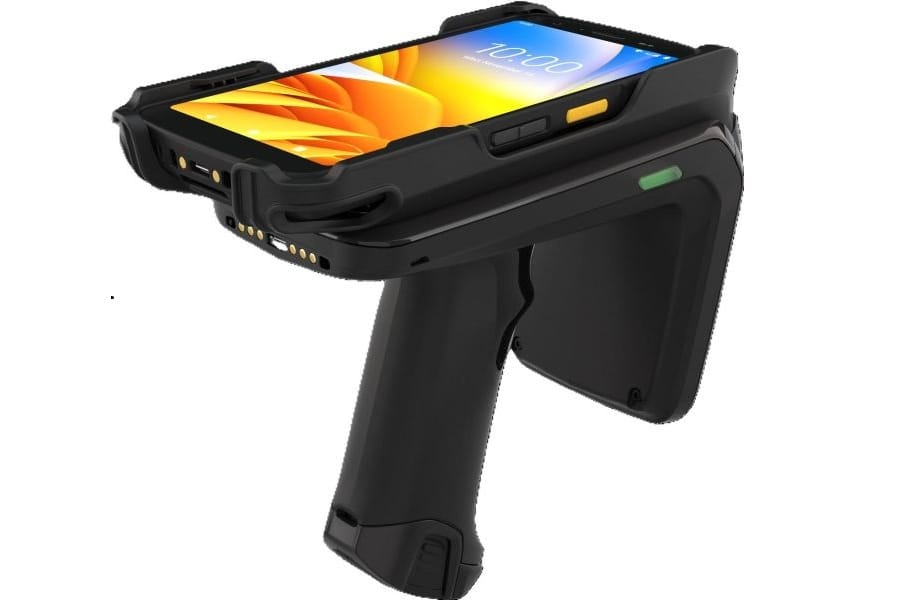
Handheld RFID Readers
Handheld RFID readers pair a directional antenna with a trigger-based scan, letting staff walk down an aisle or sweep across a shelving unit while the reader continuously captures every tag within its field. This mobility makes handheld readers ideal for spot checks, cycle counts, and full physical audits across large storage areas without needing fixed infrastructure at every location.
Fixed RFID Portals and Antennas
For high-traffic points such as storeroom doorways, loading docks, or equipment cages, fixed RFID portals and ceiling- or wall-mounted antennas can automatically capture every tagged asset that passes through, with no operator involvement at all. This is especially useful for continuously monitoring movement in and out of secure storage areas and for detecting unauthorized removal of tagged assets in real time.
Real-World Applications Across Industries
Bulk RFID scanning is not a theoretical capability — it is already in daily use across industries that manage large volumes of physical assets and need fast, reliable visibility into what they own and where it is located.
IT and Technology Asset Audits
IT departments and managed service providers use RFID-tagged laptops, servers, and network equipment to complete full hardware audits in a fraction of the time required for manual spreadsheet reconciliation, reducing both labor cost and the risk of unaccounted "ghost assets" lingering on the books.
Warehouse and Manufacturing Inventory
Warehouses and manufacturing floors rely on bulk RFID scanning to perform rapid cycle counts of tools, fixtures, and work-in-progress items, improving equipment utilization and reducing the search time typically spent hunting for misplaced tools or components.
Government, PSU, and Regulated Asset Registers
Government departments, public sector organizations, and regulated industries that must maintain audit-ready Fixed Asset Registers use bulk RFID scanning to verify hundreds of assets during internal reviews or statutory inspections, producing tamper-proof audit trails without disrupting daily operations.
Key Benefits of Bulk RFID Asset Scanning
- Dramatic time savings: Full-room audits that took hours can be completed in minutes.
- Higher accuracy: Automated reads eliminate transcription errors and skipped items common in manual counts.
- Lower labor cost: Fewer staff-hours are needed per audit cycle, freeing teams for higher-value work.
- Reduced shrinkage: Faster, more frequent audits make missing or misplaced assets easier to catch early.
- Audit-ready compliance: Every scan can be logged with a timestamp, creating a defensible record for internal and external reviews.
- Scalability: The same reader and workflow scale from a single storeroom to multi-location, multi-thousand-asset environments.
How GOBO Asset Tracking System Uses Bulk RFID Scanning
The GOBO Asset Tracking System is built as a multi-technology platform that combines RFID, barcode, GPS/GSM, BLE, and UWB, so organizations can apply the right identification method to the right asset. For bulk inventory and audit operations specifically, the system uses UHF RFID handheld readers and fixed portals to scan tagged assets in bulk, automatically comparing the scanned results against the expected asset register maintained in the platform's configurable metadata templates. Any discrepancy — a missing item, an asset in the wrong location, or an unauthorized item detected at an exit point — is instantly flagged on the dashboard, with a complete, timestamped audit trail supporting compliance reporting and internal reviews. Organizations using this bulk-scanning capability routinely reduce audit time from hours to minutes while improving overall inventory accuracy.
Implementation Considerations
Getting the full benefit of bulk RFID scanning depends on a few practical decisions made during rollout. Choosing the right tag for each asset type, positioning readers and antennas correctly, and accounting for the physical environment all directly affect real-world read performance.
- Tag selection: Passive UHF tags are the most practical, cost-effective choice for most asset tracking use cases, offering a long usable life without batteries.
- Environmental factors: Metal surfaces and liquids can attenuate RF signals, so tag placement and, in some cases, specialized on-metal tags need to be considered.
- Antenna placement: Fixed antennas at doorways or dock doors should be positioned to create a clean read zone that captures passing assets without picking up unrelated tags from adjacent areas.
- Software deduplication: Since a single tag may be read many times during one sweep, the tracking software must intelligently deduplicate reads and reconcile them against the asset register.
- Staff training: Even though scanning itself is fast and largely automated, staff should understand basic sweep technique and how to interpret audit exception reports.
Conclusion
The ability to read hundreds of tagged assets in seconds is not a marketing exaggeration — it is a direct result of how UHF RFID technology works, using radio frequency energy and anti-collision protocols to capture many tag responses in rapid succession instead of scanning one label at a time. For organizations managing large or distributed asset inventories, this translates into audits that shrink from hours to minutes, tighter control over shrinkage and misplacement, and audit-ready records generated automatically as a byproduct of routine scanning.
Ready to Get Started?
Contact GOBO Systems to learn how bulk RFID scanning can transform your asset audits. Schedule a consultation today and discover the right RFID solution for your organization.
You can also explore the GOBO Asset Tracking System to learn more about its RFID, barcode, GPS/GSM, BLE, and UWB tracking capabilities.