Quick Answer
Tracking weapon cleaning, test firing, and inspection records using spreadsheets is cumbersome, error-prone, and cannot provide the historical documentation that regulatory audits demand. The GOBO Weapon Tracking and Armory Management System maintains complete maintenance records for every weapon, automatically schedules cleaning, test firing, and inspection activities, sends timely alerts to personnel, and generates compliance-ready audit trails - transforming weapon service management from manual chaos into systematic, auditable digital processes that extend weapon lifespan, ensure safety, and meet regulatory requirements.
Quick Takeaways
- Spreadsheet-based weapon maintenance tracking is prone to data entry errors, lacks real-time visibility, and cannot scale across multiple weapons and locations.
- Digital weapon maintenance systems automatically track cleaning, test firing, and inspection records for every weapon with complete historical documentation.
- Automated scheduling links maintenance requirements to weapon usage history and automatically calculates when each weapon is due for service.
- Timely alerts notify armory personnel days or weeks in advance, enabling proactive planning instead of reactive crisis management.
- Complete maintenance history demonstrates proper care and extends weapon lifespan by ensuring preventive maintenance is never missed.
- Maintenance records provide the audit trail and compliance evidence that regulatory authorities require during inspections and investigations.
- The GOBO Weapon Tracking and Armory Management System provides integrated maintenance management, automatic scheduling, timely alerts, and compliance-ready reporting - all in a single unified platform.
Table of Contents
- The Challenge of Weapon Maintenance Record Tracking
- Why Spreadsheets Fail for Weapon Maintenance Tracking
- Types of Weapon Maintenance and Service Records
- How Digital Systems Transform Weapon Maintenance Management
- Automated Maintenance Scheduling and Alerts
- Historical Records for Audit and Compliance
- How Proper Maintenance Extends Weapon Lifespan
- Safety and Regulatory Compliance Benefits
- Why GOBO Systems for Weapon Maintenance Management
- Conclusion
- Frequently Asked Questions
The Challenge of Weapon Maintenance Record Tracking
Introduction
Every weapon in an armory - whether a handgun, rifle, or supporting equipment - requires regular maintenance to ensure operational functionality and safety. Weapons must be cleaned to prevent corrosion and fouling, test-fired to verify operational readiness, and formally inspected to identify any damage or degradation. These maintenance activities are not optional; they are fundamental responsibilities of any organization that manages firearms.
Yet despite the critical importance of weapon maintenance, most armories manage these records using spreadsheets, paper logs, or ad-hoc email communications. The result is predictable: maintenance deadlines are missed, duplicate cleaning schedules are created, inspection records are incomplete, and when an auditor asks for proof that a specific weapon was maintained according to standards, no cohesive documentation exists. Weapon maintenance management in most organizations is chaotic and unsustainable.
The GOBO Weapon Tracking and Armory Management System provides a fundamentally different approach - one where weapon maintenance is scheduled automatically, tracked digitally, recorded permanently, and made audit-ready. Weapon service management becomes a systematic process instead of a reactive scramble.
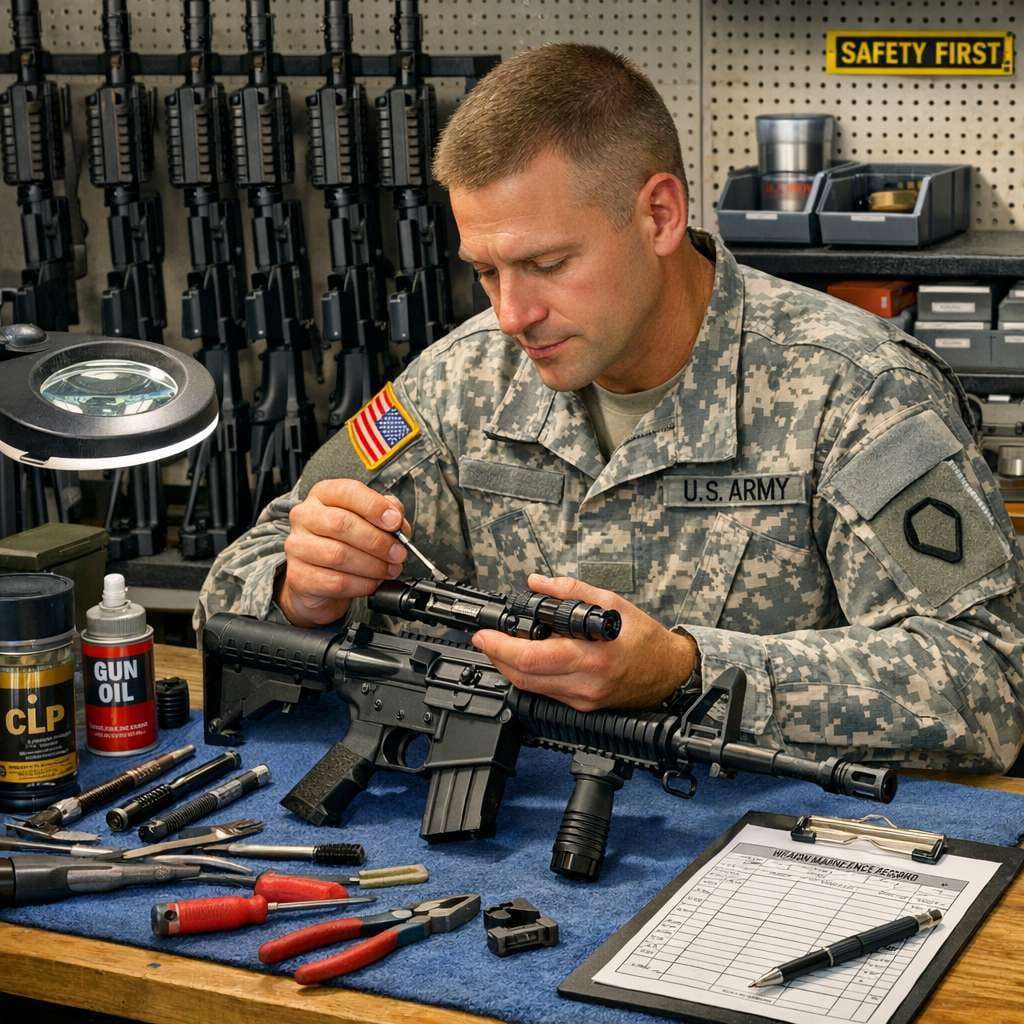
Why Spreadsheets Fail for Weapon Maintenance Tracking
Spreadsheets are a default tool for many organizations attempting to manage weapon maintenance. They seem simple enough - create columns for weapon ID, last cleaning date, last test firing date, last inspection date, and next due date. But in practice, spreadsheet-based maintenance management fails in multiple critical ways.
Manual Data Entry Is Error-Prone
Every maintenance activity must be manually entered into the spreadsheet - a process that invites transcription errors, incorrect dates, forgotten entries, and data inconsistencies. An armory officer performing maintenance must then find the correct weapon record in the spreadsheet, locate the right column, and update the date. If the person entering data makes a mistake, the mistake propagates through all subsequent calculations and alerts. There is no validation, no automated correction, and no way to prevent errors.
No Real-Time Visibility
A spreadsheet sitting on an armory officer's desktop provides no real-time visibility into maintenance status. Other personnel working with weapons have no idea which weapons are due for maintenance, which weapons recently were serviced, and which weapons are approaching their maintenance deadlines. Information is siloed in a single file, inaccessible to people who need it.
Calculation Errors and Date Inconsistencies
Manually calculating when maintenance is next due - based on the last service date plus the required maintenance interval - is prone to errors. Add 90 days to a maintenance date manually and mistakes happen. If the interval changes or different weapon types have different requirements, the complexity multiplies and errors become inevitable.
Difficult to Audit and Verify
When an auditor requests proof that a specific weapon was maintained according to standards, the armory officer must search through a spreadsheet, find the weapon record, and hope the dates are correct and complete. There is no audit trail showing who made updates, when they were made, or whether data has been altered. A spreadsheet can be easily modified after the fact - making it unsuitable as a compliance document.
No Automatic Alerts or Reminders
Spreadsheets provide no automatic alert mechanism. Maintenance deadlines pass silently. The armory officer must manually review the spreadsheet on a regular basis to identify weapons due for maintenance - something that is often overlooked during busy operational periods. By the time maintenance is conducted, the deadline may have passed by weeks.
Cannot Scale Across Multiple Locations
When weapons are distributed across multiple armory locations, managing maintenance with spreadsheets becomes impossible. Each location might maintain its own spreadsheet, creating inconsistencies, duplications, and gaps. Generating organization-wide maintenance status reports requires manual consolidation from multiple sources - a time-consuming error-prone process.
Types of Weapon Maintenance and Service Records
Comprehensive weapon maintenance management requires tracking multiple types of maintenance activities:
Routine Cleaning
- After-use cleaning following field operations or training exercises
- Preventive cleaning at regular intervals (weekly, monthly, etc.)
- Inspection cleaning to verify internal condition before operations
- Documented with date, personnel conducting cleaning, and condition noted
Test Firing and Function Verification
- Test firing at designated ranges to verify operational functionality
- Function verification to confirm reliability before deployment
- Accuracy verification to ensure sights and components are functioning
- Documented with test results, personnel conducting test, and any issues identified
Formal Inspections
- Comprehensive inspections by qualified armory officers
- Component verification (barrel condition, trigger function, safety mechanism, etc.)
- Damage assessment and condition documentation
- Documented with detailed inspection findings, any issues, and corrective actions
Repairs and Component Replacement
- Replacement of worn or damaged components
- Repairs to correct identified defects or damage
- Post-repair verification and test firing
- Documented with parts replaced, work performed, and verification results
How Digital Systems Transform Weapon Maintenance Management
Digital weapon maintenance systems eliminate the constraints that make spreadsheet-based management fail.
Complete Historical Record for Every Weapon
A digital system maintains a complete history of every maintenance activity conducted on each weapon. Every cleaning, test firing, inspection, and repair is recorded with:
- Date and time of activity
- Type of maintenance performed
- Personnel who conducted the activity
- Detailed findings and condition notes
- Any issues identified and corrective actions taken
- Permanent, tamper-proof audit trail
This complete history exists not on a personal spreadsheet but in a central system accessible to authorized personnel and auditors.
Automatic Calculation of Maintenance Due Dates
The system automatically calculates when each weapon is next due for maintenance based on:
- Predefined maintenance intervals (cleaning every 1000 rounds, test firing quarterly, etc.)
- Actual weapon usage history (weapons fired more frequently require sooner cleaning)
- Last service date recorded in the system
- Any special requirements or modifications to the standard interval
Rather than manually calculating due dates, the system does it automatically - eliminating calculation errors and ensuring consistency across all weapons.
Real-Time Maintenance Status Visibility
Authorized personnel can query the system at any time to see the maintenance status of any weapon or group of weapons:
- Weapons currently due for maintenance
- Weapons approaching maintenance deadlines
- Weapons recently serviced
- Overdue maintenance items requiring immediate attention
- Complete maintenance history for any weapon
Automated Maintenance Scheduling and Alerts
The most transformative feature of digital weapon maintenance systems is automated scheduling and alert generation. Rather than relying on manual review of spreadsheets, the system proactively manages maintenance schedules.
Automatic Due Date Calculation
When a weapon is cleaned or serviced, the system automatically calculates the next due date based on the service interval. For example, if a weapon is cleaned today and the maintenance interval is 90 days, the system automatically schedules the next cleaning for 90 days from now - no manual calculation required.
Timely Alerts to Personnel
The system generates alerts at predefined warning points - typically 7, 14, and 30 days before a maintenance deadline. Armory personnel receive these alerts through the system dashboard, email, or text notifications. This advance notice enables proactive planning instead of reactive crisis management.
Overdue Maintenance Escalation
If a maintenance deadline passes without the required service being performed, the system escalates the alert. Overdue maintenance items are flagged with increasing urgency, ensuring that critical maintenance is not indefinitely deferred. Command can see at a glance which weapons require immediate maintenance attention.
Prevents Operational Impact
Advance alerts enable armory officers to schedule maintenance during low-tempo periods instead of having multiple weapons suddenly become unavailable for service simultaneously. This planning prevents unexpected operational impacts where critical weapons are suddenly out of service due to deferred maintenance.
Historical Records for Audit and Compliance
One of the most critical functions of weapon maintenance record systems is providing the historical documentation that regulatory audits demand.
Complete Compliance Documentation
When an auditor or inspector visits an armory and asks "Can you prove that this weapon has been properly maintained according to standards?", a digital maintenance system provides an instant, comprehensive answer. The complete maintenance history for that weapon - every cleaning, every test firing, every inspection - is available with dates, personnel names, and detailed findings. No searching through paper logs, no reconstructing records, no hoping documentation exists.
Tamper-Proof Audit Trails
Digital records maintain complete audit trails showing who entered data, when it was entered, and any modifications made. Historical records cannot be altered without detection - a feature that spreadsheets cannot provide. This tamper-proof nature makes digital maintenance records suitable for legal proceedings and formal regulatory reviews.
Organizational-Wide Compliance Visibility
Organizations with multiple armory locations can generate consolidated compliance reports showing maintenance status across all weapons and locations. Executives and compliance officers can see at a glance which weapons are compliant, which are approaching deadline, and which require immediate attention.
How Proper Maintenance Extends Weapon Lifespan
Weapons are significant capital investments. A properly maintained firearm can have an operational lifespan of decades; a neglected weapon can become unreliable or unsafe within years. Digital maintenance tracking directly contributes to extending weapon lifespan.
Preventive Maintenance Never Gets Missed
With automated scheduling and alerts, preventive maintenance activities are never overlooked. Routine cleaning prevents corrosion and fouling that would otherwise degrade weapon functionality. Regular inspections catch wear early before it becomes serious damage. Prompt component replacement prevents cascading failures. All of these preventive measures are systematically applied because the system ensures they happen on schedule.
Early Problem Detection
Scheduled inspections provide regular opportunities to detect problems early - a worn barrel, a degraded spring, a loose component - before they become critical failures. Early detection enables prompt, inexpensive repairs before the problem renders a weapon inoperable.
Usage-Based Maintenance Planning
Weapons that are used more frequently require more frequent maintenance. A digital system tracks actual usage and can automatically adjust maintenance schedules based on usage patterns. A weapon fired 2000 times in a month requires sooner maintenance than one fired 200 times. The system adjusts accordingly, ensuring that high-usage weapons receive the maintenance they need.
Cost Savings Through Lifecycle Management
By extending weapon lifespan through proper maintenance, organizations reduce the frequency and cost of weapon replacement. A weapon that remains operational and reliable for 20 years instead of 10 through proper maintenance is a significant cost savings across large inventories.
Safety and Regulatory Compliance Benefits
Proper weapon maintenance is fundamentally a safety and compliance issue. Maintaining detailed service records directly supports both objectives.
Ensures Operational Safety
A weapon that is properly cleaned, regularly inspected, and test-fired is a weapon that functions reliably and safely. A weapon that is neglected and not maintained is a safety hazard - it may malfunction in critical moments, potentially harming the operator or others. Systematic maintenance records ensure that every weapon in the armory is safe and reliable.
Regulatory Compliance and Audits
Law enforcement, military, and correctional facility organizations are subject to regulatory audits that specifically examine weapon maintenance. Regulators expect complete documentation showing that organizations have systematic processes to ensure weapon safety and readiness. Digital maintenance records provide exactly this documentation - comprehensive, auditable, and tamper-proof.
Investigative Support for Incidents
If a weapon is involved in an incident or is suspected of malfunction, investigators need to know whether the weapon was properly maintained. A weapon involved in a critical incident with no maintenance records raises questions about whether proper care was taken. A weapon with complete, current maintenance records demonstrates due diligence and proper stewardship.
Liability Protection
Complete maintenance records demonstrate that an organization has taken reasonable steps to ensure weapons are safe and functional. If a weapon-related incident occurs and an investigation follows, documented evidence of proper maintenance is a significant liability protection for the organization.
Why GOBO Systems for Weapon Maintenance Management?
The GOBO Weapon Tracking and Armory Management System provides comprehensive, integrated weapon maintenance and service record tracking designed specifically for law enforcement, military, and correctional organizations.
Integrated Maintenance Management
The GOBO system integrates weapon maintenance records with overall weapon tracking and armory management. Maintenance history is linked to each individual weapon, accessible alongside custody records, usage history, and other weapon-specific information.
Automatic Scheduling Based on Actual Usage
The GOBO system tracks actual weapon usage and automatically calculates maintenance schedules based on how frequently each weapon is used. A high-usage weapon automatically receives more frequent maintenance scheduling than a weapon in reserve. This usage-aware scheduling ensures that maintenance is always appropriate to the weapon's actual operational demands.
Timely Alert Generation
Automatic alerts notify armory personnel days or weeks before maintenance deadlines, enabling advance planning. Overdue maintenance items are escalated with increasing urgency, ensuring that critical service is not indefinitely deferred.
Complete Historical Record Maintenance
Every maintenance activity is permanently recorded in the system with complete details - date, time, personnel, findings, and actions taken. This creates a comprehensive, tamper-proof audit trail suitable for regulatory review and legal proceedings.
Multi-Location Maintenance Coordination
Organizations with weapons at multiple locations can use the GOBO system to maintain unified maintenance management. All locations follow consistent standards, maintenance is scheduled systematically across all sites, and consolidated reporting provides organization-wide compliance visibility.
Compliance-Ready Reporting
The GOBO system generates compliance-ready maintenance reports that auditors and regulators expect - complete maintenance history, on-time performance metrics, overdue item tracking, and organizational compliance status. Audit preparation requires no manual document gathering or reconstruction.
Transform Your Weapon Maintenance Management
Explore the GOBO Weapon Tracking and Armory Management System to see how automated maintenance scheduling and digital record tracking transform weapon service management, or contact us to discuss your maintenance management requirements.
Conclusion
Weapon cleaning, test firing, and inspection records are not administrative busywork - they are critical safety and compliance documentation. Yet managing these records with spreadsheets is cumbersome, error-prone, and ultimately ineffective. Maintenance deadlines are missed, duplicate activities are scheduled, and when auditors demand proof that weapons were properly maintained, the documentation is incomplete.
The GOBO Weapon Tracking and Armory Management System provides law enforcement agencies, military organizations, and correctional facilities with systematic, digital weapon maintenance management. Maintenance is automatically scheduled, personnel receive advance alerts, complete records are maintained for every weapon, and audit-ready documentation is available at any time. The system ensures that weapon maintenance is never missed, that service records are complete and compliant, and that weapons are maintained safely and reliably throughout their operational lifespan.
The investment in digital weapon maintenance management pays dividends in operational safety, weapon lifespan extension, regulatory compliance, and organizational liability protection. Organizations that transition from spreadsheet-based maintenance management to GOBO's digital system report improved maintenance adherence, better audit outcomes, and greater confidence that every weapon in their inventory is properly maintained and safe.
Frequently Asked Questions
Learn More
Want to streamline your weapon maintenance tracking? Visit our GOBO Weapon Tracking and Armory Management System page or contact us to discuss how automated maintenance management can transform your armory operations.