Quick Answer
Technology is fundamentally transforming evidence rooms from manual, paper-based operations into smart, automated facilities. RFID portal readers, barcode systems, automated software, and access controls replace logbooks and file searches, enabling real-time evidence tracking, instant access controls, tamper detection, and legally defensible documentation. Modern evidence rooms are becoming centers of operational efficiency and security, where investigators access evidence instantly instead of searching for hours, and evidence security is enforced automatically rather than through human vigilance. A modern Evidence Tracking System represents the future of evidence management.
Quick Takeaways
- Technology revolution: RFID, barcode, and software automation are replacing manual evidence management with intelligent, automated systems.
- Real-time visibility: Evidence location is now known instantly rather than estimated, eliminating search time and enabling rapid investigator response.
- Automated security: RFID portal readers and tamper alerts automatically detect unauthorized access instead of relying on manual surveillance.
- Compliance assurance: Automated chain of custody documentation meets legal standards, preventing case dismissals and legal challenges.
- Operational efficiency: Evidence room automation reduces staff requirements while improving investigator productivity and case outcomes.
- Future-ready: The GOBO Evidence Tracking System brings next-generation technology to police evidence operations.
Table of Contents
Introduction: The Evidence Room Evolution
Evidence rooms in police departments have traditionally been quiet, behind-the-scenes facilities-crowded with filing cabinets, overflowing shelves, and staff performing tedious manual tasks. These spaces have changed little over decades, operating much as they did generations ago. Yet today, a technological revolution is fundamentally transforming what evidence rooms are and how they function.
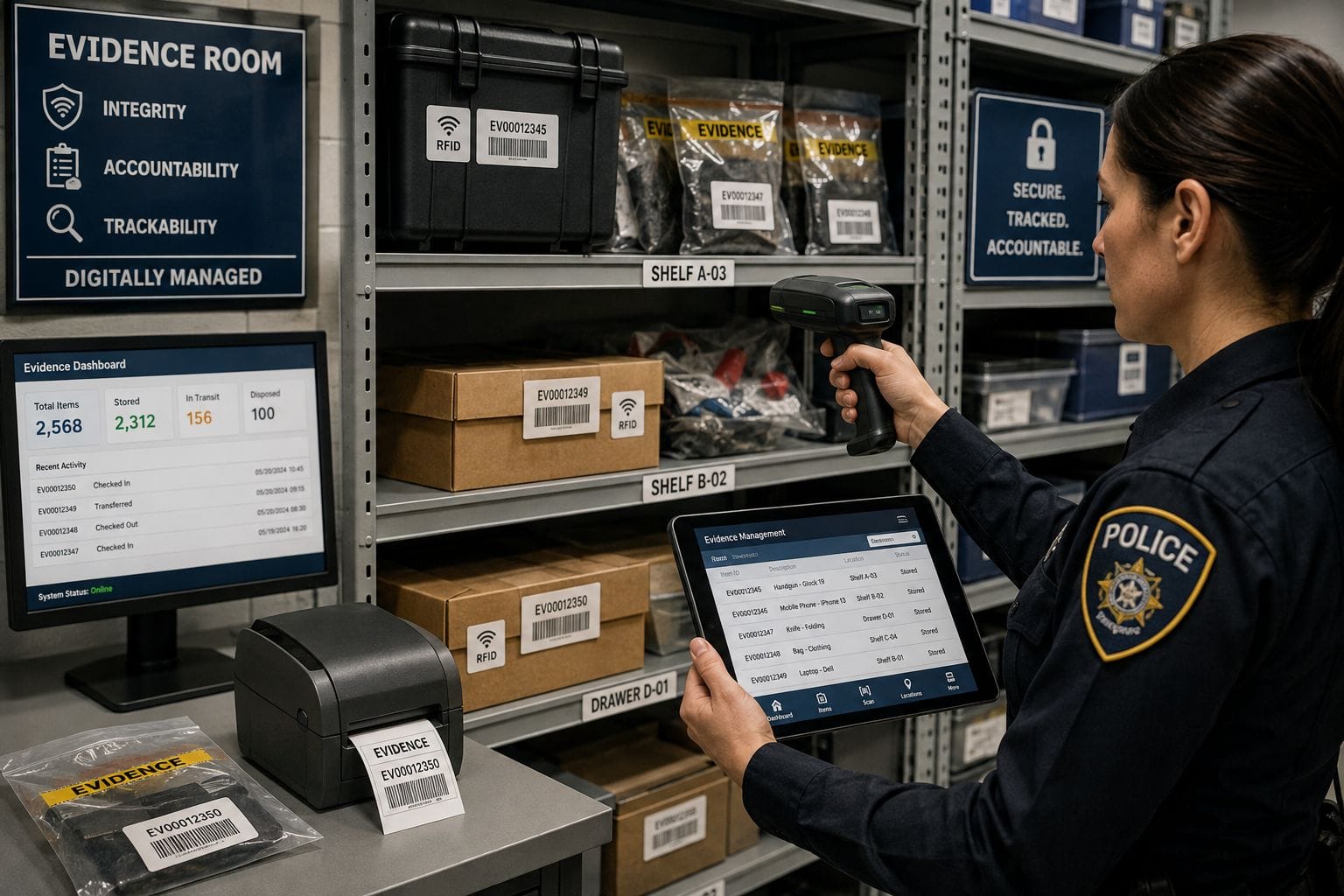
Modern evidence room technology is replacing manual operations with intelligent automation. RFID portal readers automatically detect evidence, barcode systems provide backup tracking, software systems integrate evidence data with case information, and access controls enforce security policies. What was once a purely administrative facility is becoming a technology-enabled operational center that improves investigations, prevents evidence loss, ensures compliance, and protects evidence integrity.
This transformation is not incremental improvement-it represents a fundamental reimagining of evidence management. Police departments adopting modern technology are discovering that evidence rooms can become competitive advantages, contributing directly to case success, investigator productivity, and public safety outcomes.
Legacy Evidence Room Operations
Understanding modern evidence room technology requires first examining the limitations of traditional approaches.
Manual System Challenges
Legacy evidence rooms operate using manual methods that create numerous operational challenges:
- Time-consuming searches: Locating specific evidence requires manual browsing through logbooks or filing systems, consuming 30 minutes to several hours per request.
- Lost evidence: Evidence is frequently misplaced within storage areas with no automatic detection or alert when items go missing.
- Handwritten documentation: Evidence access is recorded in handwritten logbooks with illegible entries, timestamps gaps, and no verification.
- No real-time visibility: Staff cannot determine current evidence location without physical inspection of storage areas.
- Security vulnerabilities: No access controls, no tamper detection, and no notification of unauthorized evidence access or removal.
- Staff burden: Evidence room work is highly labor-intensive, requiring staff to perform repetitive documentation and filing tasks.
Space and Storage Constraints
Physical storage limitations plague traditional evidence rooms:
- Large footprint required: Filing cabinets and shelving consume massive amounts of space, making evidence rooms one of the largest facilities in many departments.
- Inefficient space utilization: Disorganized filing and manual storage methods prevent efficient space use.
- Growth limitation: As evidence volumes increase, departments struggle to expand evidence rooms, often running out of space.
- Environmental challenges: Maintaining proper storage conditions across large manual facilities is difficult and expensive.
- Retrieval inefficiency: Inefficient storage organization makes locating specific items even more time-consuming.
Security and Accountability Gaps
Manual systems create serious security and accountability problems:
- No unauthorized access detection: Anyone with key access to evidence room can remove items without detection or notification.
- Evidence theft risk: Valuable evidence (drugs, cash, jewelry, weapons) can be stolen without immediate discovery.
- No tampering alerts: Corrupted staff can access or modify evidence without creating suspicious activity records.
- Audit trail gaps: Incomplete documentation makes accountability impossible and creates legal liability.
- Insider threat vulnerability: Corrupt officers or staff can misuse evidence with minimal risk of detection.
- Legal defensibility: When cases are challenged, incomplete documentation cannot prove proper evidence handling.
Technology Transformation
Modern technology is replacing every aspect of manual evidence management with automated, intelligent systems.
RFID Portal-Based Automation
RFID (radio frequency identification) technology is the foundation of modern evidence room transformation:
- Automatic detection: RFID tags attached to evidence are automatically detected when items pass through portal readers, without requiring staff action.
- Real-time tracking: Each detection is recorded with timestamp, evidence ID, and personnel, creating real-time location visibility.
- Instant alerts: When evidence is moved without authorization, system immediately alerts supervisors.
- No human error: Automatic detection eliminates manual scanning mistakes and documentation omissions.
- Comprehensive visibility: Evidence location and movement history is instantly available to authorized personnel.
- Tamper detection: Attempts to remove evidence without authorization trigger immediate alerts.
Barcode Integration and Tracking
Barcode systems provide backup tracking and flexibility in modern evidence management:
- Redundancy: Barcode scanning provides backup when RFID tags are damaged or obscured.
- Flexibility: Handheld barcode scanners enable evidence tracking outside main evidence room (labs, courts, storage).
- Manual override: Staff can manually scan when evidence cannot pass through RFID portals.
- Diverse evidence types: Supports tracking of evidence types incompatible with RFID portals.
- Multi-location tracking: Evidence can be tracked across multiple storage locations and facilities.
Software Integration and Intelligence
Software systems transform raw tracking data into actionable intelligence:
- Case integration: Evidence tracking integrates with case management systems, linking evidence to investigations automatically.
- Automated documentation: Chain of custody is automatically generated from tracking data without manual form completion.
- Instant queries: Investigators query system for evidence location instead of calling evidence room staff.
- Status visibility: System shows evidence status, analysis completion, and case timeline progress.
- Compliance reporting: Automated reports demonstrate legal compliance and proper evidence handling.
- Analytics: Systems provide insights into evidence handling patterns, bottlenecks, and improvement opportunities.
Advanced Security Controls
Technology enables enterprise-grade security in evidence rooms:
- Role-based access: System restricts evidence access based on staff role and case assignment.
- User authentication: Only authorized personnel with valid credentials can access system and evidence.
- Audit logging: Every access is logged with user, time, and data accessed, creating complete accountability.
- Tamper detection: System alerts when suspicious access patterns occur or unauthorized access is attempted.
- Biometric authentication: For highly sensitive evidence, fingerprint or facial recognition may be required.
- Encrypted communications: Data is encrypted to prevent unauthorized interception or access.
Benefits of Modern Evidence Room Technology
Real-Time Visibility and Tracking
Modern evidence room technology provides instant visibility into evidence location and status:
- Instant location queries: Instead of searching for hours, investigators query system and locate evidence instantly.
- No lost evidence: Automatic detection ensures evidence cannot be lost or misplaced without immediate detection.
- Movement history: System displays complete evidence movement history, showing when item was accessed and by whom.
- Status visibility: Investigators see evidence analysis status, forensic testing progress, and timeline completion.
- Multi-location tracking: Evidence location is known whether in main evidence room, lab, court, or storage facility.
Time Savings and Productivity
Automation dramatically improves operational efficiency:
- Evidence search time: Reduced from 30 minutes to several hours to seconds through instant system queries.
- Annual savings: Large departments handling thousands of evidence items save thousands of investigator hours annually.
- Staff reduction: Evidence room staffing requirements are reduced 40-60% through automation, freeing staff for investigations.
- Administrative burden reduction: Automatic documentation eliminates manual paperwork and form completion.
- Investigation acceleration: Faster evidence access enables rapid investigation progression and faster case resolution.
Enhanced Security and Tamper Detection
Technology provides automatic security protection:
- Unauthorized access prevention: RFID portals automatically detect and alert when evidence is removed improperly.
- Access controls: Role-based restrictions prevent unauthorized personnel from accessing sensitive evidence.
- Tamper alerts: System immediately notifies supervisors of suspicious activity or unauthorized access attempts.
- Corruption prevention: Complete audit trails make corruption detectable, creating strong deterrent against evidence misuse.
- Evidence loss prevention: Real-time tracking and unauthorized access detection prevent evidence theft.
Compliance and Legal Protection
Automated systems ensure legal compliance:
- Chain of custody: Automatic documentation meets federal evidentiary standards for chain of custody proof.
- Legal admissibility: Courts accept automated documentation as more reliable than manual logbooks.
- Compliance demonstration: Automated reports prove compliance with Brady disclosure, evidence preservation, and handling standards.
- Case protection: Proper documentation prevents cases from being dismissed due to evidence handling questions.
- Legal defense: Tamper-proof audit trails provide evidence that proper procedures were followed.
The Transformation Journey
Police departments transforming their evidence rooms typically follow a structured approach:
- Assessment: Evaluate current evidence volume, space, workflows, and identify modernization goals.
- Planning: Develop implementation timeline, identify budget, and secure department stakeholder buy-in.
- Infrastructure: Install RFID portal readers, secure connectivity, and computer systems.
- Software deployment: Implement evidence tracking software and integrate with case management systems.
- Training: Train evidence room staff, investigators, and supervisors on new systems and procedures.
- Tagging and migration: Apply RFID tags to evidence and migrate existing records into digital system.
- Go-live: Activate system and transition evidence room to fully digital operations.
- Optimization: Monitor performance, adjust processes, and leverage analytics for continuous improvement.
The Future of Evidence Management
Evidence room technology continues to evolve, bringing new capabilities:
- Cloud-based systems: Multi-agency evidence sharing with real-time visibility across jurisdictions.
- Environmental monitoring: Sensors tracking temperature, humidity, and storage conditions to ensure evidence preservation.
- Advanced analytics: AI-powered insights predicting evidence needs and optimizing room operations.
- Mobile access: Investigators accessing evidence information from the field with mobile applications.
- Integration expansion: Evidence systems integrating with forensic labs, courts, and federal databases.
- Predictive capabilities: Systems predicting evidence-related bottlenecks before they impact investigations.
Conclusion
Technology is fundamentally transforming evidence rooms from manual, behind-the-scenes facilities into smart, automated operational centers. The transformation is not about incremental improvement-it represents a shift in how law enforcement thinks about evidence management and its role in investigations and case success.
Police departments adopting modern evidence room technology are discovering that modernization delivers tangible benefits: investigations accelerate through instant evidence access, security improves through automatic controls, compliance is assured through automated documentation, and evidence room staff are freed from tedious manual tasks to support investigations. The evidence room becomes a technology-enabled asset rather than a administrative burden.
The GOBO Evidence Tracking System represents the future of evidence management-purpose-built for law enforcement, leveraging RFID automation, integrated with police operations, and delivering measurable improvements in security, efficiency, and case outcomes. The evidence room revolution is underway, transforming police operations from the ground up.