Quick Answer
Manual evidence tracking systems (logbooks, spreadsheets, filing systems) are fundamentally inadequate for modern law enforcement, resulting in lost evidence, chain of custody documentation gaps, and legal compliance failures. Digital evidence tracking systems using RFID automation provide real-time location visibility, tamper-proof audit trails, role-based access controls, and legally defensible documentation. The choice between manual and digital is not about preference-it's about preventing case dismissals, protecting evidence integrity, and ensuring investigations succeed. A modern Evidence Tracking System transforms evidence management from a liability into a competitive advantage.
Quick Takeaways
- Manual systems fail: Logbooks and spreadsheets cannot track evidence in real-time, document access accurately, or prevent loss and theft.
- Legal liability: Manual documentation is rejected by courts as unreliable chain of custody proof, causing case dismissals and civil litigation.
- Time waste: Evidence searches in manual systems consume 30 minutes to hours, diverting investigators from solving crimes.
- Digital automation: RFID and barcode systems automatically track evidence, create tamper-proof documentation, and detect unauthorized access instantly.
- Compliance assurance: Digital systems meet federal evidentiary standards, Brady disclosure requirements, and chain of custody compliance without question.
- Modern solution: The GOBO Evidence Tracking System provides law enforcement-grade automation with portal-based RFID detection and real-time tracking.
Table of Contents
- Introduction: The Evidence Tracking Evolution
- Manual Evidence Tracking Systems: History and Limitations
- Digital Evidence Tracking Systems: Modern Technology
- Direct Comparison: Manual vs Digital
- Why Police Departments Choose Digital
- Implementing Digital Evidence Tracking
- Conclusion
- Frequently Asked Questions
Introduction: The Evidence Tracking Evolution
For decades, police departments managed physical evidence using methods that had remained largely unchanged since the early 20th century: handwritten logbooks, filing cabinets, and manual records. These systems worked-barely-when police departments handled hundreds of evidence items per year and legal standards were less stringent. But modern law enforcement operates in a different world: thousands of evidence items, complex legal compliance requirements, sophisticated criminal investigations, and electronic discovery demands that manual systems cannot meet.
Today, a critical divide exists in law enforcement evidence management: departments using manual evidence tracking systems face escalating problems-lost evidence, broken chains of custody, legal compliance failures, and case dismissals-while departments using digital evidence tracking systems report transformed operations, improved case outcomes, and protected evidence integrity.
This blog post directly compares manual and digital evidence tracking approaches, examining the specific advantages and disadvantages of each, and explains why modern police departments are abandoning legacy systems. The choice between manual and digital is not about budget or preference-it's about fundamental operational effectiveness and legal compliance. Understanding this comparison is essential for police leadership evaluating evidence management modernization.
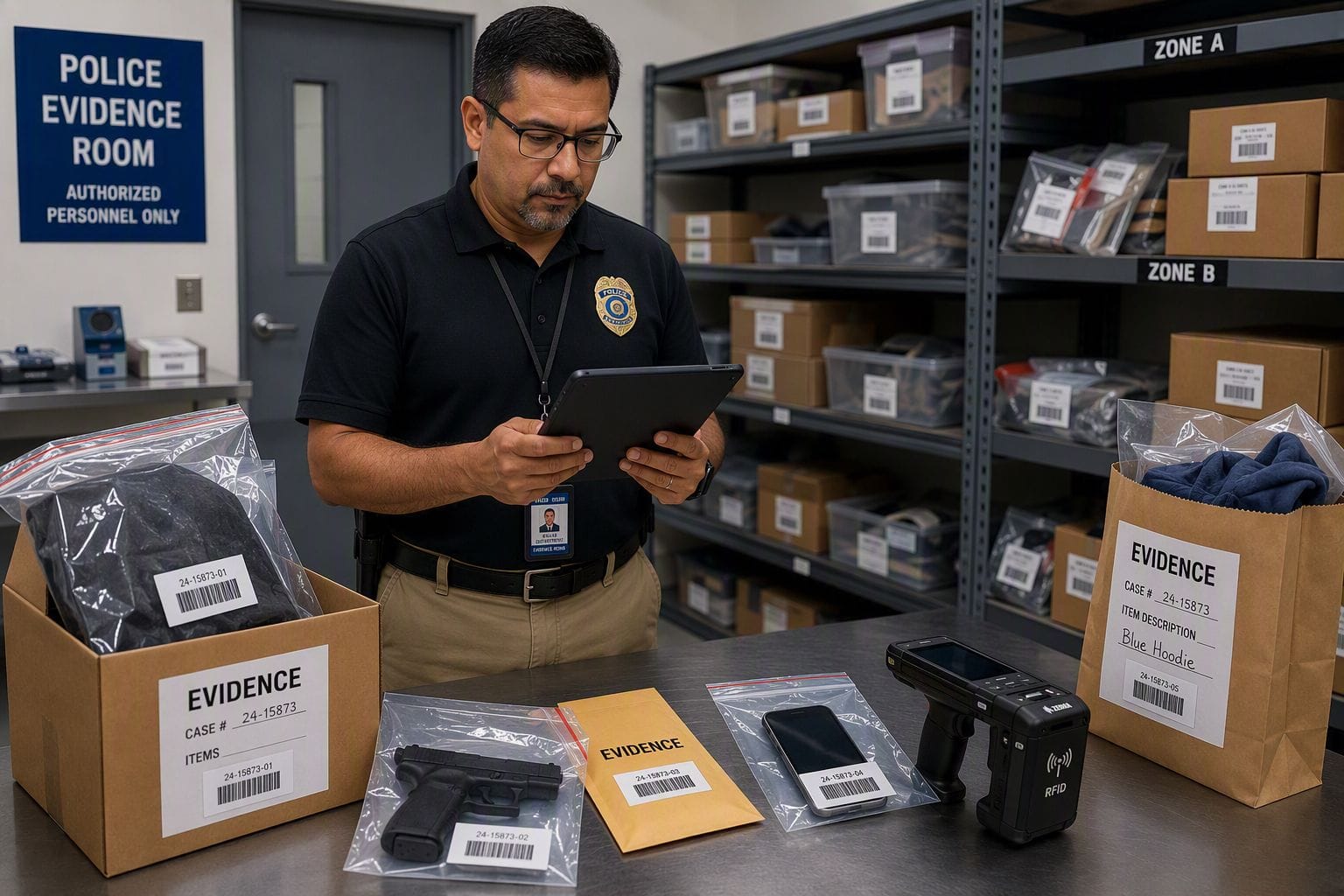
Manual Evidence Tracking Systems: History and Limitations
Before examining digital systems, understanding manual methods reveals why they are inadequate for contemporary law enforcement.
The Logbook Method
The traditional evidence logbook is a bound journal where staff record evidence handling events by hand:
- Process: When evidence is checked out or returned, staff write the time, evidence ID, who accessed it, and purpose in a logbook.
- Real-time challenge: Documentation often occurs hours after actual handling, creating gaps and inaccuracies.
- Legibility issues: Handwriting is frequently illegible, creating ambiguity in documentation.
- Searching difficulty: Finding historical records requires manual page-by-page review of multiple logbooks.
- Tampering vulnerability: Entries can be erased, altered, or removed without detection.
- Legal inadequacy: Courts increasingly reject handwritten logbooks as insufficient proof of chain of custody.
Filing Cabinet Storage
Physical evidence storage in manual systems relies on filing cabinets, shelving, and organized (or disorganized) physical space:
- Location tracking: Staff must physically search for evidence by memory or incomplete location records.
- No real-time visibility: Impossible to know instantly where specific evidence is located.
- Storage inefficiency: Valuable evidence room space is consumed by filing systems.
- Evidence loss: Items are frequently misplaced within storage areas or removed and never returned.
- Security limitations: No access controls, no tamper detection, no notification of unauthorized access.
- Environmental risks: Evidence may degrade without environmental monitoring or climate control.
Spreadsheet-Based Tracking
Some police departments attempt to modernize by using spreadsheet tools (Excel, Google Sheets) instead of logbooks:
- Manual data entry: Information must be entered manually, creating entry errors and delays.
- No real-time updates: Evidence location reflects what was entered, not current actual location.
- Data tampering: Spreadsheet cells can be edited or deleted undetected, destroying integrity.
- No access restrictions: Anyone with access can view, modify, or delete records.
- No audit trail: Changes cannot be tracked; cannot determine who modified records or when.
- Scaling problems: Large spreadsheets become unwieldy, slow, and unreliable.
Inherent Limitations of Manual Systems
Manual evidence tracking systems, regardless of specific method, share fundamental limitations:
- No automation: All tracking and documentation requires manual human effort, creating bottlenecks.
- Human error: Manual entry, filing, and searching are error-prone and create inaccuracies.
- No real-time visibility: Cannot instantly determine current location of any evidence item.
- No tamper detection: Impossible to detect unauthorized access, removal, or tampering.
- No access controls: Cannot restrict who accesses what evidence based on role or case assignment.
- Time consumption: Searching, locating, and documenting evidence consumes hours of investigator and staff time.
- Legal inadequacy: Modern courts reject manual documentation as insufficiently reliable for chain of custody proof.
Digital Evidence Tracking Systems: Modern Technology
Digital evidence tracking systems replace manual methods with automated technology specifically designed for evidence management.
RFID Portal-Based Detection
Modern RFID evidence tracking systems use radio frequency identification technology:
- Automatic detection: RFID tags attached to evidence are automatically detected when evidence passes through portal readers at evidence room exits/entries.
- No manual scanning: Detection occurs automatically without requiring staff to scan barcodes or enter data.
- Real-time tracking: Each detection automatically records time, evidence ID, and personnel responsible.
- Instant visibility: Software displays current evidence location and history instantly on demand.
- Unauthorized access alerts: When evidence is moved without authorization, system immediately alerts staff.
- Complete audit trail: Every access event is recorded with timestamp, personnel, and duration-creating legally defensible documentation.
Barcode Backup Systems
Modern systems combine RFID with barcode technology for redundancy and flexibility:
- Backup identification: If RFID tag is damaged or obscured, barcode scanning provides alternative identification method.
- Manual override: Staff can scan barcodes for evidence that cannot pass through RFID portals.
- Flexibility: Supports different evidence types and handling scenarios.
- Compatibility: Barcode scanning works with handheld devices for evidence accessed outside main evidence room.
- Reliability: Dual-method tracking ensures evidence is always tracked, regardless of circumstances.
Software Integration and Automation
Digital evidence tracking software transforms raw tracking data into actionable intelligence:
- Case integration: Software integrates with case management systems, linking evidence to cases and investigations.
- Automated documentation: Chain of custody documentation is automatically generated from tracking data-no manual forms or paperwork.
- Real-time location queries: Investigators instantly query where specific evidence is located instead of searching.
- Investigation status: Software shows evidence status, analysis progress, and timeline status for each case.
- Compliance reporting: Automated reports demonstrate compliance with legal requirements and evidence handling standards.
- Analytics: Systems provide insights into evidence handling patterns, bottlenecks, and improvements.
Role-Based Access Controls
Digital systems enforce security through role-based access controls:
- User authentication: Only authorized personnel with valid credentials can access the system.
- Role-based restrictions: Investigators only see evidence related to their cases; supervisors have broader access.
- Biometric security: For sensitive evidence, fingerprint or facial recognition may be required for access.
- Access logging: Every access is logged with user, time, and data accessed-creating accountability.
- Breach detection: System alerts when unauthorized access attempts are made.
- Compliance audit: Complete audit trail of all access proves proper security controls and compliance.
Direct Comparison: Manual vs Digital
Tracking Accuracy and Real-Time Visibility
Manual Systems: Evidence location is estimated based on last known logbook entry, which may be hours or days old. Multiple items may be misplaced, and staff cannot determine actual current location without physical search.
Digital Systems: Evidence location is known in real-time through automatic RFID detection. System displays exact location, time of last movement, and personnel responsible. Instant visibility eliminates searching and immediately reveals missing or misplaced evidence.
Chain of Custody Documentation
Manual Systems: Chain of custody is documented manually in logbooks with gaps, illegible handwriting, and lack of timestamp precision. Courts question documentation reliability, sometimes excluding evidence based on incomplete or unclear documentation.
Digital Systems: Chain of custody is automatically generated from RFID detection data with precise timestamps, personnel identification, and duration. System creates tamper-proof, authenticated documentation that courts accept without challenge for evidence admissibility.
Security and Tamper Detection
Manual Systems: No access controls, no tamper detection, no notification of unauthorized access. Evidence can be stolen or accessed without any record or alert. Corrupt staff can misuse evidence without detection.
Digital Systems: RFID portal readers instantly detect unauthorized removal. Role-based access controls restrict who can access specific evidence. Tamper alerts notify supervisors of suspicious activity. Complete audit trail documents all access, preventing corruption.
Legal Compliance
Manual Systems: Documentation often fails to meet federal evidentiary standards, Brady disclosure requirements, or chain of custody compliance. Cases are dismissed due to insufficient evidence documentation.
Digital Systems: Automated documentation meets all federal standards, Brady requirements, and chain of custody compliance. Tamper-proof audit trails prove proper handling, preventing cases from being challenged on evidence handling grounds.
Operational Efficiency
Manual Systems: Investigators waste 30 minutes to multiple hours per evidence request searching, locating, and documenting access. Evidence room staff spend significant time on filing and manual documentation instead of serving investigators.
Digital Systems: Investigators instantly locate evidence with software queries. Automatic documentation eliminates manual paperwork. Evidence room staff time is reduced 40-60%. Productivity gains redirect resources to investigations and public safety.
Cost-Benefit Analysis
Manual Systems: Low initial cost but high operational cost. Requires extensive evidence room staffing, consumes investigator time, creates case dismissal risk, and exposes departments to civil liability. Total cost of ownership is high.
Digital Systems: Higher initial investment (RFID infrastructure, software, implementation) but substantial ROI through time savings, eliminated evidence loss, improved case prosecution, and reduced civil liability. ROI typically achieved in 2-3 years.
Why Police Departments Choose Digital
Police departments across the country are transitioning from manual to digital evidence tracking systems because the benefits are transformative:
- Case success: Proper evidence management ensures evidence admissibility and case prosecution success.
- Evidence integrity: Real-time tracking and security controls ensure evidence is not lost, stolen, or contaminated.
- Investigator productivity: Eliminating evidence searches frees thousands of investigator hours annually for actual investigations.
- Staff efficiency: Evidence room automation reduces staffing requirements and operational costs.
- Legal protection: Automated documentation provides legally defensible proof of proper evidence handling.
- Civil liability reduction: Preventing evidence mishandling eliminates wrongful conviction and litigation risks.
- Compliance assurance: Automated systems meet all regulatory and legal requirements without question.
- Public trust: Modern, professional evidence management enhances community confidence in law enforcement.
Implementing Digital Evidence Tracking
Departments transitioning from manual to digital systems typically follow a structured implementation approach:
- Assessment phase: Evaluate current evidence volume, space, and workflows to determine system requirements.
- Planning: Develop implementation timeline, identify stakeholders, and secure budget.
- Infrastructure installation: Install RFIF portal readers, secure connectivity, and server infrastructure.
- Software deployment: Configure system, integrate with case management, and test functionality.
- Staff training: Train evidence room personnel, investigators, and supervisors on new processes.
- Data migration: Migrate existing evidence records into digital system (if transitioning from partial records).
- Go-live and support: Activate system, provide ongoing support, and optimize based on feedback.
- Continuous improvement: Monitor performance, adjust processes, and leverage analytics for optimization.
Conclusion
The comparison between manual and digital evidence tracking systems is not a close call. Manual systems-logbooks, filing cabinets, spreadsheets-were designed for an earlier era and are fundamentally inadequate for modern law enforcement. They result in lost evidence, broken chains of custody, investigator time wasted, legal compliance failures, and case dismissals.
Digital evidence tracking systems represent a transformation in evidence management capability. RFID automation, real-time tracking, tamper detection, and legally defensible documentation eliminate the problems that plague manual systems while dramatically improving operational efficiency and case outcomes.
The question for police departments is not whether to modernize evidence tracking-it is when. Departments that lead this transition will discover that evidence management becomes a strength rather than a vulnerability, investigations accelerate, cases are more successfully prosecuted, and public safety outcomes improve. The GOBO Evidence Tracking System provides the specific solution police departments need: purpose-built for law enforcement, RFID-based automation, and complete integration with police operations.