Quick Answer
Government offices in India and worldwide run on physical files - land records, registration deeds, disaster relief approvals, and subsidy paperwork all move on paper between desks. A File Tracking System built on RFID file tracking or barcode file tracking gives every file a unique digital ID, tracks its real-time location, and creates a tamper-proof audit trail. This closes the gaps that cause stalled property disputes, delayed disaster relief, and subsidy leakage. The GOBO File and Document Tracking System is a purpose-built file tracking system for government offices that delivers exactly this visibility and accountability.
Quick Takeaways
- Paper still runs government: Land records, deeds, relief files, and subsidy claims move physically between desks, and every hand-off is a chance for delay or tampering.
- Land records are the most disputed: Missing or delayed mutation and partition files stall inheritance, fuel litigation, and freeze infrastructure projects for years.
- Registration deeds need a chain of custody: A single lost or altered deed file can undo decades of property rights and trigger costly legal battles.
- Disasters cannot wait on paperwork: Relief and emergency fund files must clear desks in hours, not days - a delayed approval file has real human cost.
- Subsidy leakage is a file problem: Without an audit trail, welfare and subsidy files get stalled, duplicated, or diverted before reaching the rightful beneficiary.
- RFID & Barcode Solution: The GOBO File and Document Tracking System is an enterprise-grade file tracking system for government offices that combines RFID file tracking and barcode file tracking for real-time visibility and accountability.
Key Technology Terms Defined
- File Tracking System
- A system that gives every physical file a unique digital identity and records its location, movement, and custody history in real time, replacing manual registers and movement diaries.
- RFID File Tracking System
- A file tracking system that uses Radio Frequency Identification tags and readers to detect a file's location and movement automatically, without a line-of-sight scan.
- Barcode File Tracking System
- A file tracking system that uses a printed barcode label scanned at check-in and check-out points to log a file's movement and current custodian.
- File Tracking System for Government Offices
- A government-grade deployment - such as the GOBO File and Document Tracking System - built to handle high file volumes, multi-department workflows, and strict compliance and audit requirements found in public administration.
Table of Contents
Introduction: The Paper Trail Behind Every Government Decision
Walk into any tehsil office, municipal corporation, sub-registrar's office, or district collectorate anywhere in India - or into a public records office in any country - and you will find the same scene repeated: shelves and almirahs stacked floor to ceiling with files tied in red cloth, waiting for the next signature. Behind almost every government decision, whether it is a land mutation, a welfare payment, or a disaster relief sanction, sits a physical file moving from desk to desk, department to department, officer to officer. This is the reality of bureaucracy: enormous volumes of paper, and an even larger volume of red tape governing how that paper must move.
The consequences of a single "lost" or "delayed" file are rarely small. A stalled land mutation file can freeze a family's inheritance for years. A misplaced infrastructure approval file can delay a road, a school, or a hospital project by months. A relief fund file that sits on a desk too long can mean a flood-affected family waits weeks for compensation they desperately need. And every time a file "goes missing" conveniently at the exact moment a bribe is expected, public trust in government erodes a little further. Citizens do not experience corruption or inefficiency as abstract statistics - they experience it as a specific file, on a specific desk, that nobody can locate.
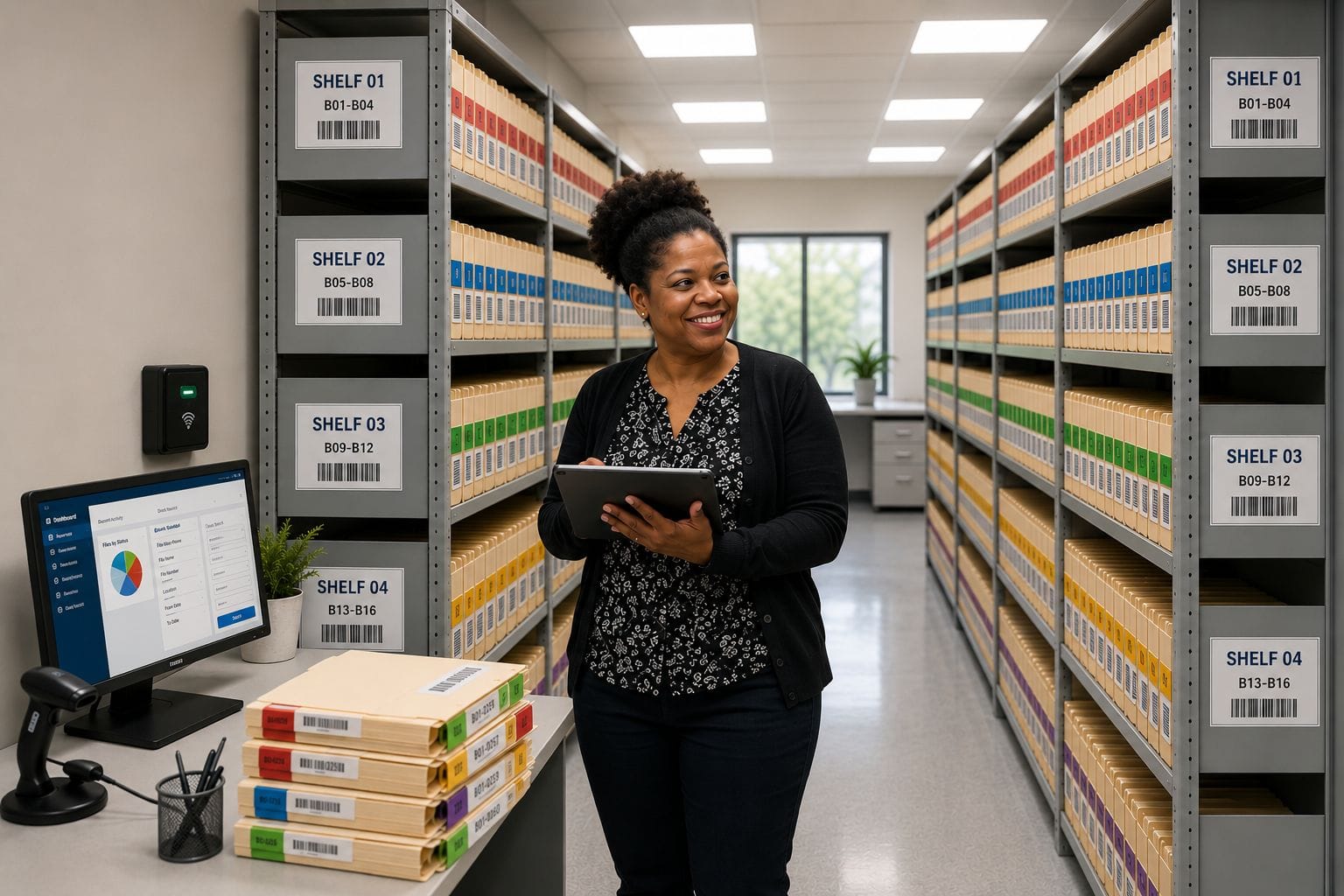
This is exactly the problem a modern Physical File Tracking System (FTS) is built to solve. Instead of relying on handwritten movement registers and institutional memory, a File Tracking System assigns every physical folder a unique digital identity using a barcode, QR code, or an RFID tag. Every time the file changes hands, it is scanned or automatically detected, creating a live, tamper-proof record of exactly where the file is, who has it, and how long it has been there. What was once invisible - the daily journey of a file through the machinery of government - becomes fully visible, searchable, and accountable.

For government departments in India and worldwide, this is no longer a "nice to have" IT upgrade - it is a governance necessity. The sections below examine the specific areas of public administration where the absence of a reliable file tracking system causes the most damage, the technology features every effective system must have, and the path forward for offices ready to modernize.
The Critical Sectors Crying Out for File Tracking
Not every government file carries the same weight, but some categories of files are so central to citizens' lives, livelihoods, and safety that any delay or tampering causes outsized harm. A file tracking system for government offices transforms how these specific sectors operate.
Land Records, Mutation & Partition Files
Nowhere is the cost of poor file management felt more sharply than in land records. Mutation files (updating land ownership after sale, inheritance, or gift) and partition files (dividing joint family property among heirs) are among the most frequently delayed documents in any revenue office. When a mutation file goes missing at the patwari's desk or sits unprocessed at the tehsildar's office for months, real families cannot register a sale, cannot secure a bank loan against their land, and cannot settle an inheritance dispute.
- Delayed inheritance: A missing mutation file can freeze legal heirship for years, leaving widows, elderly parents, or children unable to claim what is legally theirs.
- Fuel for land disputes: When there is no verifiable record of where a partition file is or who last touched it, rival claimants and local power brokers exploit the confusion, turning administrative delay into a full-blown property dispute.
- Stalled infrastructure growth: Highway expansions, industrial corridors, and irrigation projects all depend on clean land records. A single untraceable mutation file can hold up a land acquisition process - and an entire project - indefinitely.
- Unauthorized tampering risk: Without a digital chain of custody, mutation entries and partition records can be altered, backdated, or swapped between the time a file leaves one desk and reaches the next, with no way to prove when the change occurred or who made it.
A File Tracking System attaches a unique QR code, barcode, or RFID tag to every land record file the moment it is opened. Every desk transfer - from patwari to revenue inspector to tehsildar to sub-divisional officer - is logged with a timestamp and an officer ID. If a mutation file has been sitting at one desk for an unusual number of days, the system flags it automatically. If a partition record is checked out and returned with altered pages, the movement log makes it possible to pinpoint exactly when and where the file was accessible to be tampered with. This alone removes the single biggest excuse used to justify delay in land offices worldwide: "the file cannot be found."
Registration Deeds
Property registration offices - sub-registrar offices in India, land registries and deed offices internationally - are custodians of some of the most legally consequential paper a citizen will ever produce. A registration deed is the physical proof of ownership transfer, and it is often the single most important document a family owns after their identity papers.
- Physical vulnerability: Deed files stored in paper form are exposed to fire, flood, silverfish, and simple misfiling - risks that have already destroyed irreplaceable property records in offices around the world.
- Loss during internal movement: Deeds are frequently pulled for verification, litigation, court production, or citizen inspection. Each of these movements is a moment where the document can be misplaced or swapped if there is no tracking discipline.
- Transparency during verification: When a citizen or a bank applies to verify a property's registration history, long delays in retrieving the correct deed erode confidence in the registration office and slow down real estate transactions that depend on quick verification.
- Tamper concerns in high-value transactions: Because registration deeds underpin large financial transactions, they are a prime target for insider tampering - a risk that only a verifiable chain of custody can meaningfully reduce.
By tagging every registration deed file with a barcode or RFID chip at the point of registration, an office creates a permanent, searchable movement history for that document's entire life - from initial registration, through every subsequent verification request, to long-term archival storage. When a citizen asks "where is my property's deed file and who has accessed it," the office can answer in seconds instead of days, with a record that cannot be quietly edited after the fact.
Disaster Management & Relief Files
In disaster response, time equals lives. Whether it is a flood in Assam, a cyclone on the eastern coast, an earthquake, or a wildfire anywhere in the world, the speed at which government machinery can approve resource deployment, release emergency funds, and clear logistics directly determines how many people receive help in time.
- Resource deployment approvals: Deploying NDRF or SDRF teams, boats, relief material, or medical supplies often requires a physical approval file to move through multiple sign-offs at the district and state level - delays here mean rescue teams and supplies arrive late.
- Emergency fund release: Compensation for damaged homes, crop loss, or loss of life requires sanction files to pass through finance and revenue departments. A file stuck on one desk during a crisis can delay payments to an entire affected village.
- Logistical clearance: Transport permits, customs clearance for relief material, and inter-agency coordination all depend on physical paperwork moving quickly between control rooms, district magistrates, and field units.
- Visibility during chaos: Disaster response already involves managing confusion on the ground; senior officers cannot afford to also lose track of where critical approval files physically are inside their own office.
A File Tracking System gives disaster management authorities real-time visibility into every relief and approval file moving through the system during an emergency. Control rooms can see, at a glance, which desk is holding a resource deployment file and for how long, and automated escalation alerts push a stalled file straight to a senior officer's attention instead of letting it sit unnoticed. In a crisis, this visibility is not an administrative convenience - it directly shortens the time between a disaster striking and help arriving.
Government Subsidy & Relief Fund Schemes
Agricultural subsidies, housing scheme grants, pension disbursals, and welfare relief funds are some of the highest-volume, highest-scrutiny files any government office handles. These are also the files most vulnerable to bottlenecks, and in the worst cases, to deliberate leakage.
- Bottlenecked approvals: A farmer's subsidy claim, a beneficiary's housing scheme application, or a widow's pension file can sit unprocessed for months when there is no visibility into where it is stuck in the approval chain.
- Accountability at every desk: Without a movement log, no one can be held responsible for a subsidy file that was delayed for weeks - or for a bribe demanded to "speed things along."
- Ensuring funds reach the rightful beneficiary: Relief and subsidy fraud frequently exploits gaps in paperwork - duplicate claims, ghost beneficiaries, or files quietly diverted before final disbursal. A verified, auditable file trail makes this kind of manipulation far harder to hide.
- Audit trail to eliminate leakage: Auditors reviewing a welfare scheme need to reconstruct exactly which officer approved which file and when. A digital chain of custody gives them exactly that, replacing guesswork with evidence.
When every subsidy and relief file is tagged and tracked, the entire approval chain becomes visible - from the block office where the application is first filed, through the verification desk, to the treasury that releases payment. Bottleneck alerts flag any file that has been sitting idle beyond an acceptable number of days, and the resulting audit trail gives government auditors and citizens alike concrete proof of how - and whether - public money reached the people it was meant for.
Ready to Bring Accountability to Your Department's Files?
The GOBO File and Document Tracking System is built for the realities of land records offices, registration departments, disaster management authorities, and subsidy scheme administrators. For a pilot discussion or product walkthrough, contact the GOBO team.
Key Features of an Effective Physical File Tracking System
Not every barcode label or spreadsheet qualifies as a genuine file tracking system. For a government office - where files carry legal weight and public accountability - the system needs specific, non-negotiable capabilities.
- Unique Digital ID (QR / Barcode / RFID) on every file: Every physical folder, from a single-page application to a thick land record dossier, is affixed with a unique QR code, barcode, or RFID tag at the moment it is created. This digital ID becomes the file's permanent identity for its entire lifecycle - through every desk, department, and archive it ever passes through.
- Real-time location and movement logs: The system must record, at every hand-off, exactly who has the file, which desk or department currently holds it, and how long it has been there. This is the single most important feature: it replaces "I think it's with the revenue clerk" with a verifiable, timestamped answer.
- Automated bottleneck alerts: If a file sits on a specific desk beyond a defined threshold - three days, five days, whatever the department sets - the system should automatically notify a senior officer. This turns file delay from something that is discovered by accident (or by an angry citizen) into something that is flagged proactively before it becomes a crisis.
- Role-based access control and a strict digital chain of custody: Sensitive files - land disputes under litigation, classified security files, or high-value subsidy approvals - should only be accessible to authorized personnel. The system needs to enforce who can check a file in or out, and it must maintain an unbroken, tamper-evident custody record showing every single person who has ever touched the file.
Together, these four capabilities turn a pile of paper into a governed, accountable record-keeping process - without requiring the office to abandon physical files altogether, which is often impractical given legal retention and evidentiary requirements for original documents.
| Capability | Manual Movement Register | RFID / Barcode File Tracking System |
|---|---|---|
| Real-time file location | No | Yes — instant lookup |
| Tamper-proof custody trail | No | Yes — legally defensible |
| Automated desk-delay alerts | No | Yes — configurable thresholds |
| Role-based file access control | No | Yes — per file, per officer |
| Audit-ready reporting | Manual reconstruction | One-click reports |
| Scalability across departments | Poor | Enterprise-grade |
Conclusion & The Path Forward
Physical files are not going away from government offices any time soon - land records, registration deeds, court references, and archival compliance requirements all demand original paper documents for the foreseeable future, in India and worldwide. But the way those files are handled does not have to remain stuck in the past. A Physical File Tracking System is the practical bridge between old-school paper administration and full digital governance - it does not ask a department to digitize every historical record overnight, but it does demand that every file moving through the office today be visible, accountable, and protected from tampering.
For land records offices tired of disputes over "missing" mutation files, registration departments that need to prove a deed's integrity, disaster management authorities that cannot afford a single hour of delay, and subsidy scheme administrators under pressure to eliminate leakage, the case for modernization is no longer theoretical - it is operational and urgent. Citizens are asking for transparency. Auditors are asking for evidence. Senior officers are asking for accountability. A modern RFID or barcode file tracking system answers all three demands at once.
The path forward starts with a single decision: stop treating file movement as invisible. Tag the files, track every hand-off, alert on every delay, and hold every desk accountable. That is the foundation of citizen-centric governance, and it is available to government departments today - not as a distant digital transformation goal, but as a practical reform that can begin with the very next file that crosses an officer's desk.
Bring Accountability to Every File in Your Department
The GOBO File and Document Tracking System gives land records offices, registration departments, disaster management authorities, and subsidy scheme administrators real-time file visibility, automated bottleneck alerts, and a tamper-proof digital chain of custody - built specifically for government offices in India and worldwide.
Explore the Product Request a Demo